




A Lewis & Clark Adventure With Katelyn - Page 3
| Previous | Next | Page 1,2,4,5 |
 |
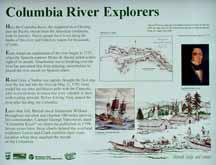 |
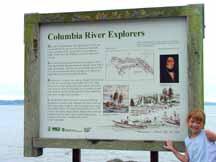
The next day we decided to head directly to the mouth of the Columbia River and establish a home base at the Columbia Shores RV Park in Chinook, Washington where we have previously stayed. This location would be perfect for our further exploration of areas where Lewis and Clark traveled. As we neared our destination, we were driving next to the northern shore of the Columbia where we could see the Astoria Bridge, which connected with Ellice Point in the distance. We were now passing the area where Lewis and Clark spent some of the most miserable days of their adventure holed up against the terrible weather in an uncomfortable location on November 10 thru 14, 1805. The journals describe the situation as follows: "... after going a mile found the waves too high for our canoes and were obliged to put to shore. We unloaded the canoes, and having placed the baggage on a rock above the reach of the tide, encamped on some drift logs which formed the only place where we could lie, the hills rising steep over our heads to the height of five hundred feet. All as well as ourselves were thoroughly wet with the rain, which did not cease during the day; it continued violently during the night, in the course of which the tide reached the logs on which we lay, and set them afloat".
The next day November 11, 1805, Clark wrote: "... we are truly unfortunate to be Compelled to lie 4 days nearly in the Same place at a time that our day are precious to us, The Wind Shifted ... the Indians left us and Crossed the river which is about five miles wide through the highest Sees I ever Saw a Small vestle ride, their Canoe is Small, maney times they were out of Sight before the were 2 miles off Certain it is they are the best canoe navigators I ever Saw The tide was 3 hours later to day than yesterday and rose much higher, the trees we camped on was all on flote for about 2 hours from 3 untill 5 oClock P M, the great quantities of rain which has fallen losenes the Stones on the Side of the hill & the Small ones fall on us, our Situation is truly a disagreeable one our Canoes in one place at the mercy of the waves our baggage in another and our Selves & party Scattered on drift trees of emense Sizes, & are on what dry land they can find in the Crevices of the rocks & hill Sides ...". The journals then continue as follows: "A hunter was despatched in hopes of finding some fresh meat, but the hills were so steeps and covered with undergrowth and fallen timber, that he could not penetrate them, and he was forced to return. About twelve o'clock we were visited by five Indians in a canoe: they came from above this place on the opposite side of the river, and their language much resembles that of the Wahkiacum: they called themselves Cathlamahs. In person they are small, ill made, and badly clothed; though one of them had on a sailor's round jacket and pantaloons, which, as he explained by signs, he had received from the whites below the point: we purchased from them thirteen red charr, a fish which we found very excellent. After some time they went on board the boat, and crossed the river, which is here five miles wide, through a very heavy sea".
On November 12, the journals continue: "About three o'clock a tremendous gale of wind arose, accompanied with lightning, thunder, and hail: at six it became light for a short time, but a violent rain soon began and lasted during the day. During this storm one of our boats, secured by being sunk with great quantities of stone, got loose, but drifting against a rock, was recovered without having received much injury. Our situation became now much more dangerous, for the waves were driven with fury against the rocks and trees, which till now had afforded us refuge: we therefore took advantage of a low tide, and moved about half a mile round a point [Megler Point] to a small brook [Megler Cove], which we had not observed till now on account of the thick bushes and driftwood which concealed its mouth. Here we were more safe; but still cold and wet, our clothes and bedding rotten as well as wet, our baggage at a distance, and the canoes, our only means of escape from this place, at the mercy of the waves: we were, however, fortunate enough to enjoy good health, and even had the luxury of getting some fresh salmon and three salmon trout in the brook. Three of the men attempted to go round a point [Point Ellice] in our small Indian canoe, but the high waves rendered her quite unmanageable; these boats requiring the seamanship of the natives themselves to make them live in so rough a sea".
On November 13, it was written: "During the night we had short intervals of fair weather, but it began to rain in the morning, and continued through the day. In order to obtain a view of the country below, captain Clarke followed up the course of the brook, and with much fatigue, and after walking three miles, ascended the first spur of the mountains. The whole lower country was covered with almost impenetrable thickets of small pine, with which is mixed a species of plant resembling arrowwood, twelve or fifteen feet high, with a thorny stem, almost interwoven with each other, and scattered among the fern and fallen timber: there is also a red berry, somewhat like the solomon's seal, which is called by the natives, solme, and used as an article of diet. This thick growth rendered travelling almost impossible, and it was rendered more fatiguing by the steepness of the mountain, which was so great as to oblige him to draw himself up by means of the bushes. The timber on the hills is chiefly of a large tall species of pine, many of them eight or ten feet in diameter at the stump, and rising sometimes more than one hundred feet in height. The hail which fell two nights since is still to be seen on the mountains: there was no game, and no traces of any, except some old signs of elk: the cloudy weather prevented his seeing to any distance, and he therefore returned to camp, and sent three men in the Indian canoe to try if they could double the point [Point Ellice] and find some safer harbour for our canoes. At every flood-tide the seas break in great swells against the rocks, and drifts the trees among our establishment, so as to render it very insecure. We were confined as usual to dried fish, which is our last resource".
On November 14 the journals state: "It rained without intermission during last night and to-day: the wind too is very high, and one of our canoes much injured by being dashed against rocks. Five Indians from below came to us in a canoe, and three of them having landed, informed us that they had seen the men sent down yesterday. At this moment one of them arrived, and informed us that these Indians had stolen his gig and basket: we therefore ordered the two women who remained in the canoe, to restore them; but this they refused, till we threatened to shoot, when they gave back the articles, and we then ordered them to leave us. They were of the Wahkiacum nation. The man now informed us that they had gone round the point [Point Ellice] as far as the high sea would suffer them in the canoe, and then landed, and that in the night he had separated from his companions, who had gone further down: that at no great distance from where we are is a beautiful sand beach and a good harbour. Captain Lewis concluded to examine more minutely the lower part of the bay, and taking one of the large canoes was landed at the point, whence he proceeded by land with four men, and the canoe returned nearly filled with water".
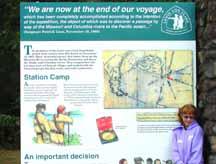 |
On November 15, 1805 the Lewis and Clark party found their way around Point Ellice (where the Astoria Bridge connects with the Washington shore) as further described in the journals: "It continued raining all night, but in the morning the weather became calm and fair: we therefore began to prepare for setting out, but before we were ready a high wind sprang up from the southeast, and obliged us to remain [Their camp at Megler Cove]. The sun shone until one o'clock, and we were thus enabled to dry our bedding and examine our baggage. The rain, which has continued for the last ten days without an interval of more than two hours, has completely wet all our merchandise, and spoiled some of our fish, destroyed the robes, and rotted nearly one half of our few remaining articles of clothing, particularly the leather dresses. About three o'clock the wind fell, and we instantly loaded the canoes, and left the miserable spot to which we have been confined the last six days. On turning the point [Point Ellice] we came to the sand beach, through which runs a small stream from the hills; at the mouth of which is an ancient village of thirty-six houses; which has at present no inhabitants except fleas. Here we met Shannon, who had been sent back to meet us by captain Lewis. .... It was now apparent that the sea was at all times too rough for us to proceed further down the bay [Baker Bay] by water: we therefore landed, and having chosen the best spot we could select, made our camp of boards from the old village [Station Camp, site of today's McGowan, Washington] ". It is here at Station Camp that the explorers realized their goal and celebrated their accomplishment of "finding those waters communicating with the Pacific Ocean". Clark wrote: "... I landed and formed a camp on the highest Spot I could find between the hight of the tides, and the Slashers in a Small bottom this I could plainly See would be the extent of our journey by water, as the waves were too high at any Stage for our Canoes to proceed any further down. ..." . This camp became their base camp for the next 10 days, November 15 thru 24, 1805, and was about 3 miles east of where we made our base camp at the RV park (about 199 years later, less 3 months).
We arrived at the RV park in the early afternoon. After we were settled in, Katelyn challenged both grandma and papa to a game of lawn darts. Of course, Katelyn made up the rules of the game, which made it very difficult for either to effectively challenge her. Later, Diana and Katelyn worked for several hours on the scrapbook they were putting together to document the trip.
 |
| Previous | Top | Next |